Human activity has various consequences for pollinating insects.
Temperature variations caused by climate change make survival conditions more hostile for pollinators. These two conditions cause physiological impacts—such as increased mortality rates due to altered activity patterns—and a reduction in food resources due to changes in phenological cycles or the disappearance of some plants.
Two other anthropogenic factors that have a significant impact on pollinators are land use, habitat fragmentation, and the use of pollutants and pesticides. Both of these activities, like climate change, cause a reduction in the resources available to pollinators and an increase in mortality rates. Their vulnerability is increased, and population distribution is altered both geographically and numerically.
The impact of human activities on pollinators has long been recognized, and data from the “IUCN Red List of Threatened Italian Bees” indicates that, of 151 native wild bee species, 34 (about 22%) are endangered.
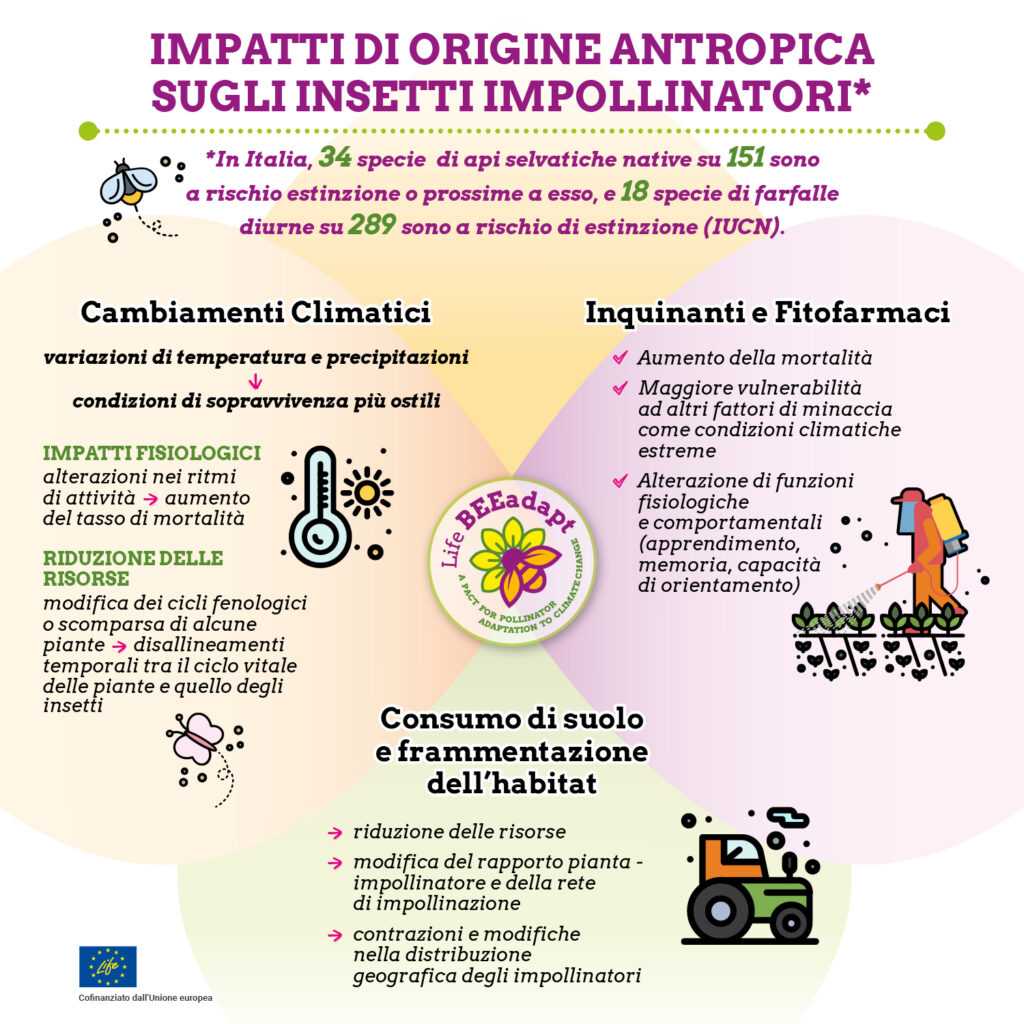
Graphic created by: IDM graphic
Sources:
Xiao, Y., Li, X., Cao, Y. et al. The diverse effects of habitat fragmentation on plant–pollinator interactions. Plant Ecol 217, 857–868 (2016). https://doi.org/10.1007/s11258-016-0608-7 https://www.eca.europa.eu/Lists/ECADocuments/SR20_15/SR_Pollinators_IT.pdf Potts S. et al., “Status and trends of European pollinators”. “Key findings of the STEP project”, 14 gennaio 2015.
– FAO, “The power of pollinators: why more bees means better food”, 24 agosto 2016.
L. A. Garibaldi et al., “Mutually beneficial pollinator diversity and crop yield outcomes in small and large farms”, Science Magazine, 2016.
IPBES, “The assessment report of the Intergovernmental Science-Policy Platform on Biodiversity and Ecosystem Services on pollinators, pollination and food production”, 2016. Sanchez-Bayo F., A.G. Wyckhuys K., “Worldwide decline of the entomofauna: A review of its drivers”, 31 gennaio 2019.
Forum economico mondiale, “The Global Risks Report 2020”, 15ª edizione, 15 gennaio 2020 Bellucci V., Piotto B., Silli V. (a cura di), 2021. Piante e insetti impollinatori: un’alleanza per la biodiversità. ISPRA, Serie Rapporti.