LIFE BEEadapt has left tangible signs of its presence in the areas where it has been implemented: to name just a few, in the Europa Park of Aprilia there are many new trees and plant species, the pollinators of the Tuscan-Emilian Apennines National Park have numerous beehotels in which to reproduce, and numerous companies in the Agro Pontino have joined the Pact for the protection of pollinators from climate change, adopting more sustainable practices.
This last example demonstrates that this isn’t just about practical interventions, but also about experimenting with a new collaborative, multilevel governance model that is starting to bear fruit. Nearly 200 entities have signed the Pact for Pollinators’ Adaptation to Climate Change, a document that agrees to avoid practices that harm the health of pollinators (for example, avoiding the use of pesticides), to install structures that support their reproduction, such as beehotels, and to create green infrastructure to ensure easy feeding throughout the year.
The Pact is just one of the tools developed by the project to coordinate the planned actions. Over the years, a methodological framework has been developed, which was then structured into the “BEEadapt Model”, which takes the form of a replicability protocol that has been implemented by project partners in many other Italian regions.
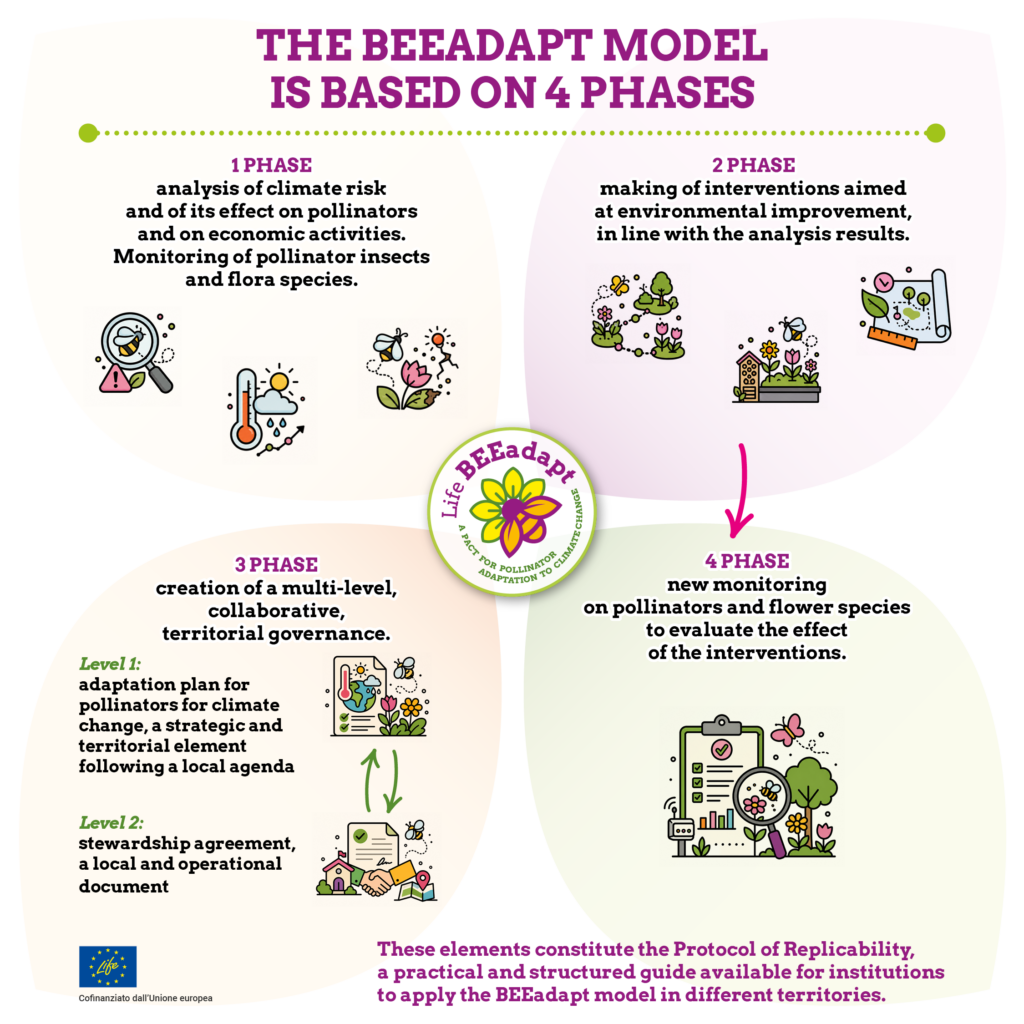
The model was transferred, through the signing of a Memorandum of Understanding and a participatory process (roadshow), to the Municipality of Jesi, the UNESCO Alto Molise MAB area, the Pollino National Park, the Municipality of San Benedetto del Tronto and the Sentina Regional Nature Reserve, the Lombardy Ticino Valley Park, the Alta Murgia National Park, and the Municipality of Bisceglie.
The model developed through this tool can be replicated in other territorial contexts, helping to disseminate effective strategies for protecting pollinators.